Why Choose a Walkie Pallet Jack for Your Warehouse?
Why Choose a Walkie Pallet Jack for Your Warehouse?
A warehouse can lose minutes at every turn: a pallet waits beside a dock, an aisle narrows, or a worker must move a load across a busy floor. A Walkie Pallet Jack offers powered travel without a riding platform, making it worth considering for short-to-medium moves, tight spaces, and frequent pallet transfers. The fit depends on load weight, travel distance, floor condition, and shift length. Not a universal fix.
The 2024 MHI Annual Industry Report, produced with Deloitte, found that 55% of surveyed supply-chain leaders planned to increase technology investment. That figure reflects broad supply-chain spending, not walkie pallet jack purchases. Still, it highlights a practical question for warehouse managers: which equipment can improve everyday movement without adding unnecessary complexity? Compare turning space, battery needs, operator training, and service support before choosing.
Lean manufacturing expert Shigeo Shingo wrote, “The most dangerous kind of waste is the waste we do not recognize.” His warning suits material handling: waiting, excess travel, and repeated manual effort can hide in ordinary routines. A powered jack may reduce pushing effort, but it will not repair poor slotting or a congested aisle. Measure the route. Watch a real shift. Then compare the machine’s capacity and controls with the work being done. Small details matter—like a threshold that jolts a loaded pallet or a charger placed too far from the staging area. The best choice is often less dramatic than expected. It should make routine moves safer and smoother, while leaving room to question whether the process itself needs changing.
What a Walkie Pallet Jack Is and How It Works
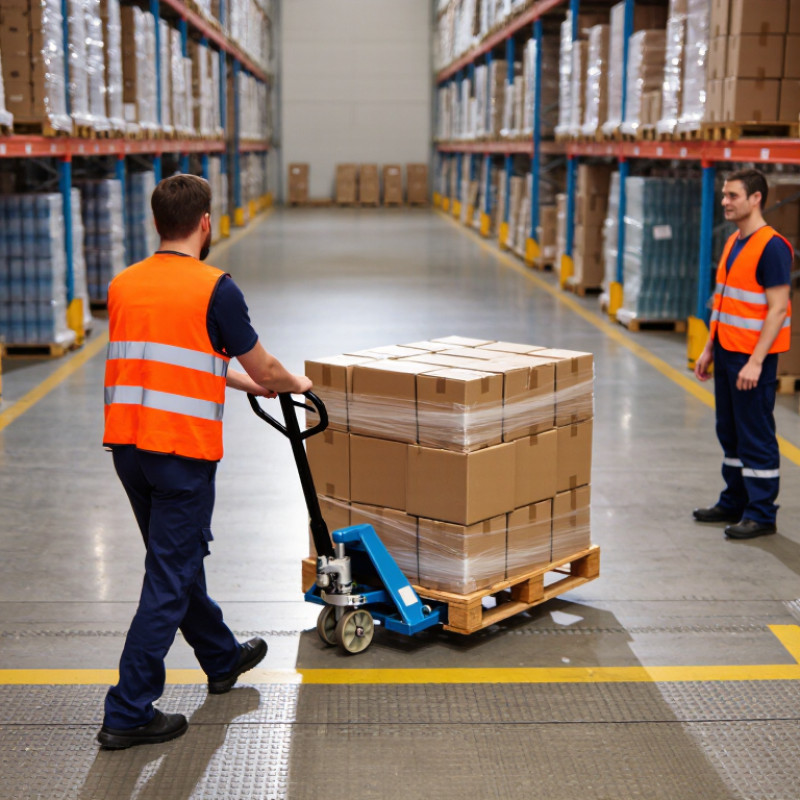
A walkie pallet jack is a powered pallet truck operated by a person walking beside or behind it. The forks slide beneath a pallet, while a motor drives the wheels and a powered lift raises the load enough to move it. No riding platform. The tiller steers the truck and usually carries controls for travel, braking, and lifting.
The operator guides the tiller through warehouse aisles and uses the controls to move or lower the pallet. At a dock, for example, the forks can enter a loaded pallet, lift it slightly, and carry it across the floor. Small movements matter. Load weight, turning space, floor condition, and visibility all affect control.
The U.S. Bureau of Labor Statistics reported 4.8 recordable injury cases per 100 full-time workers in transportation and warehousing in its 2022 Survey of Occupational Injuries and Illnesses. The private-industry rate was 2.7. These figures are sector-wide, not specific to pallet jacks, but they highlight the need for careful material handling. A walkie jack can reduce manual pushing effort, yet it cannot correct a poorly balanced load or a slick floor. I would not treat it as a cure-all.
How Walkie Pallet Jacks Move Loads Through a Warehouse
A walkie pallet jack moves a load by keeping the operator on foot behind the machine. The forks slide beneath a pallet, then a hydraulic lift raises it just clear of the floor. A powered drive carries the load; the operator steers with the tiller and controls travel from its handle. The lift is modest, but enough to cross smooth warehouse floors. That matters.
At a picking face, an operator can collect a pallet, travel along an aisle, and position it near a packing station without climbing onto a vehicle. The load should sit evenly across both forks, with heavier items low and centered. Slow down before corners and dock plates. A small turn can shift a poorly stacked load. OSHA’s powered-industrial-truck guidance stresses operator training and safe operating practices; motorized hand trucks are included in its truck classifications (29 CFR 1910.178).
Movement also depends on the route. Check floor joints, aisle width, pedestrian crossings, and turning space before choosing a jack. MHI’s 2024 Annual Industry Report found that 55% of surveyed supply-chain professionals planned to increase technology investment. That figure describes broader supply-chain plans, not pallet-jack performance, but it reflects pressure to improve material flow. A walkie jack can help with short, frequent trips. Still, congestion can erase the time saved. The turning space is easy to underestimate.
Why Choose a Walkie Pallet Jack for Your Warehouse?
How Walkie Pallet Jacks Move Loads Through a Warehouse
Walkie pallet jacks move palletized loads between receiving, storage, and dispatch areas. Comparing common pallet footprints helps with checking fork fit and planning aisle space. Dimensions are rounded; confirm the pallet and load specifications before selecting equipment.
Key Benefits for Warehouse Operations
A walkie pallet jack can make short, frequent pallet moves less strenuous. The operator walks behind the machine and controls travel and lifting from the handle. That suits tight aisles, loading areas, and pick zones where a forklift may feel cumbersome. Powered movement can help workers move heavier loads with less pushing and pulling, though it does not remove the need for safe handling practices. In its 2023 Survey of Occupational Injuries and Illnesses, the U.S. Bureau of Labor Statistics reported 4.4 recordable cases per 100 full-time workers in transportation and warehousing, compared with 2.4 across private industry. The figures cover many causes, not pallet-jack use alone, but they underline why reducing physical strain matters.
Tips: Match capacity to the heaviest planned load, not the average one. Check the route for floor cracks, ramp angles, and blind corners. Keep both hands near the controls and move slowly when visibility is limited. Battery charging and daily inspections need real time in the shift plan. Small details count.
A walkie model may improve flow when pallets travel short distances all day, but it is not automatically the right choice. Narrow turning space, uneven floors, and long travel routes can limit its value. Observe an actual shift before choosing. A two-minute trial can reveal an awkward handle height or a congested crossing that a specification sheet will miss.
Where Walkie Pallet Jacks Fit Best
Walkie pallet jacks fit best in warehouses with short to moderate travel distances, frequent stops, and loads that need moving between nearby work areas. An operator walks behind the truck, guiding it through receiving zones, staging lanes, or replenishment routes. This arrangement can be practical where space is limited and a ride-on forklift would feel oversized. Think of a narrow aisle, a pallet of cartons, and a delivery bay only a few turns away.
They are also useful in retail stockrooms, small distribution centers, and production areas where pallets move in steady, predictable batches. Electric models can reduce the physical effort of moving heavier loads, while manual units may suit lighter, occasional tasks. Floor conditions matter: uneven thresholds, steep ramps, and damaged concrete can make handling harder and less controlled. Measure aisle width and turning space with the actual pallet in place. A clear specification sheet does not show every awkward corner.
A walkie pallet jack is not automatically the right choice for every route. Long travel distances can tire an operator, and frequent lifting to high storage positions calls for different equipment. Load weight, pallet condition, charging access, and operator training should all be considered. Sometimes the best fit is less convenient than expected. Test the route during a busy shift, not only when the warehouse is quiet.
Factors to Consider When Choosing a Model
Why Choose a Walkie Pallet Jack for Your Warehouse?
Factors to Consider When Choosing a Model
Choose capacity from the heaviest load you actually move, including the pallet. Leave a practical margin; repeated trips near the rated limit can strain equipment and slow work. Check lift height, fork length, and pallet entry clearance against your real loads. Measure the narrowest aisle and turning points, too. A specification sheet cannot reveal a tight corner beside a stacked rack. Fit matters. A paper plan can still mislead, so test a loaded route where possible.
Consider travel distance, daily duty cycle, floor condition, and charging access before comparing batteries. Uneven concrete and dock plates can affect control and stability. Handle height, tiller reach, and braking response matter during repeated stops. MHI’s 2024 Annual Industry Report found that 55% of surveyed supply-chain leaders were increasing investment in technology and innovation. That broad trend is not a reason to buy extra features; choose controls and battery options that match your workload. Ask operators to test the tiller with gloves on. Small discomforts become obvious over a full shift. Also check service access and parts availability. These details are easy to overlook, and I would not assume a higher-capacity model is automatically the safer or more efficient choice.