Please provide the source article or the name and verified quotation of the Bow Type Laying Up Machine expert you want cited. Without a source, I can’t reliably attribute a statement to a real industry expert.
A bow type laying up machine is used to combine several insulated conductors or cable cores into one finished cable. Its rotating bow carries the cores around a central axis, creating a controlled helical lay. Pay-off stands feed each core, while guides bring them together before the cabling point. A capstan and take-up system then pull and wind the assembled cable.
The bow’s speed and the line’s take-up speed work together to set the lay length. If the bow rotates faster, the cores form tighter turns; if the line moves faster, the lay becomes longer. Tension matters too. Uneven tension can leave one core loose, causing a lumpy cable surface or inconsistent geometry. Operators typically check guides, brakes, and core alignment before running production. Small adjustments can make a visible difference.
This machine is useful when a stable, compact cable structure is needed, but its suitability depends on core count, diameter, and material. It also has limits: rotating bows create mechanical forces, so speed and loading must stay within the machine’s rated range. Setup can be finicky. In practice, a short trial run helps reveal rubbing, vibration, or uneven winding before a full production run. Not every cable needs this process.
A bow type laying-up machine brings several insulated cable cores together and twists them into one assembly. Individual cores unwind from pay-off reels and pass through guides toward a central point. One core may run straight through the machine, while the others travel around it. The rotating bow carries these cores in a controlled path.
The bow keeps moving. Its rotation, combined with the forward pull of the capstan, creates the helical lay. Operators adjust the relationship between bow speed and line speed to set the lay length. Too much tension can stretch or deform a core; too little may leave the bundle loose. Small details matter. Guides should be aligned, and reel brakes should feed smoothly.
After the cores meet, a closing die or forming guide helps shape the bundle before it reaches the take-up reel. During setup, operators can check the lay by measuring the distance between repeated turns and inspecting the cable surface. A clean, even pattern is a useful sign, but it does not replace checks for tension and core damage. The first run may need adjustment; machine settings rarely suit every cable construction equally well.
| Process Stage | Typical Machine Component | What Happens | Purpose and Quality Considerations |
|---|---|---|---|
| 1. Material preparation | Pay-off stands and bobbins | Insulated conductors or other prepared elements are loaded onto the pay-off positions and routed toward the laying point. A central element may be fed separately when the cable design requires one. | Correct bobbin loading and material routing help prevent tangling, surface damage, and interruptions during production. |
| 2. Tension setting | Pay-off tension controls | Each element is supplied with controlled tension as it leaves its bobbin. The appropriate setting depends on the material, conductor size, and product construction. | Consistent tension helps keep the laid-up elements even and reduces slack, stretching, or unwanted deformation. |
| 3. Element guidance | Guides and pre-forming or closing dies | The individual elements are guided toward a common forming point and arranged in the required order around the cable axis. | Accurate guidance supports the specified core arrangement and helps maintain a uniform finished cable shape. |
| 4. Bow rotation | Rotating bow assembly | The bow rotates around the machine axis while the elements move through the laying section. This rotation creates the relative movement that forms the lay. | The bow-based design provides a compact way to produce a regular lay. The suitable operating setup depends on the machine configuration and product requirements. |
| 5. Laying and closing | Laying point and closing die | The elements come together and are laid around one another, or around a central element, according to the cable design. | Lay direction, lay length, and element arrangement affect the cable’s geometry and handling characteristics. They are set for the product being manufactured. |
| 6. Optional taping | Taping unit, where fitted | Some machine configurations apply a wrapping tape over the laid-up core to hold the elements together or prepare the assembly for a subsequent process. | Taping is not present on every machine or required for every cable construction; the need depends on the product specification. |
| 7. Haul-off and take-up | Capstan or haul-off and take-up reel | The formed core is pulled through the machine and wound onto a take-up reel. Line speed and take-up operation are coordinated with the laying process. | Stable haul-off and winding help maintain consistent production and reduce the risk of loose or uneven winding. |
| 8. In-process inspection | Operator checks and production controls | Operators check the arrangement, surface condition, winding, and relevant product dimensions during production. Electrical or other product tests are performed as required by the product specification. | Regular checks help identify deviations early. Inspection criteria should be based on the cable design and applicable production requirements. |
| Why choose a bow type design? | Machine layout and rotating bow system | A bow type machine is one option for laying up multiple cable elements. Its suitability depends on the required product construction, production rate, element dimensions, and factory layout. | Before selection, confirm the allowable material and bobbin sizes, number of elements, required lay specifications, line speed, changeover needs, and available floor space with the machine supplier. |
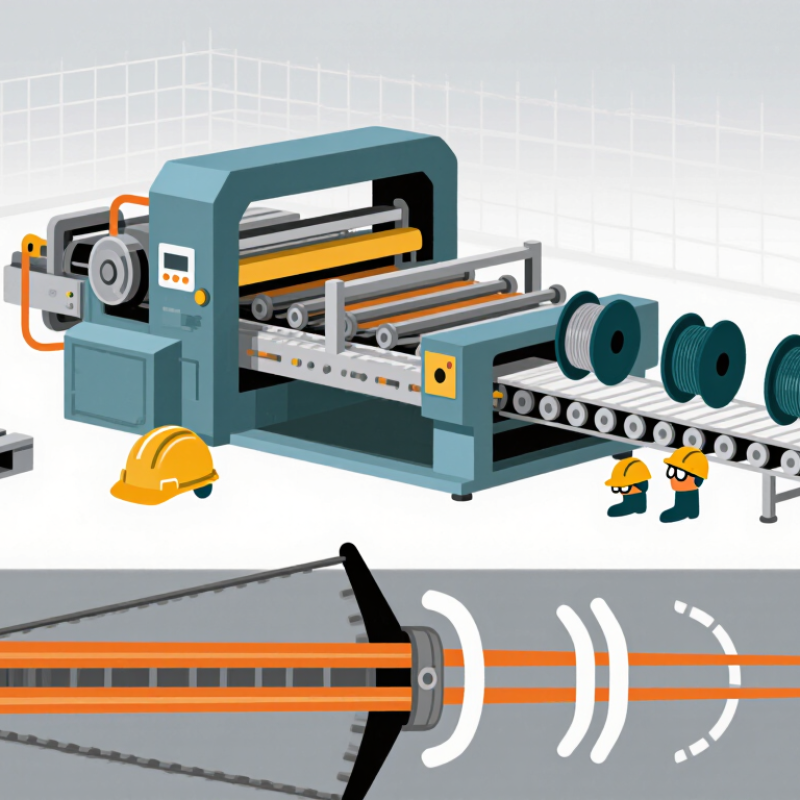
Machine layouts and available functions vary. The exact process sequence, operating limits, and quality checks should be confirmed against the selected machine configuration and the product specification.
A bow-type laying-up machine suits fabrics that curl, skew, or stretch during spreading. Its bowing roller helps control lateral distortion before layers reach the cutting table. Common choices include jersey, rib knit, interlock, and elastane blends used for T-shirts, leggings, sportswear, and underwear. The fabric should feed evenly. Excessive tension can still distort soft knits.
Woven cotton, polyester, and blended fabrics can also work, especially for shirts, uniforms, and lightweight home textiles. Textile Exchange’s Materials Market Report 2024 estimates that global fiber production reached 124 million tonnes in 2023, with polyester making up about 57 percent. That figure signals the scale of synthetic textiles, not a guarantee that every polyester fabric suits every machine. Surface finish, weight, width, and roll condition matter.
For coated, laminated, bulky, or highly elastic materials, check the machine’s working width, roll capacity, and tension controls against actual fabric samples. A trial lay is useful: inspect the edges and grain after spreading, then check whether the layers shift during cutting. Small details matter. Some fabrics still resist neat alignment, and that deserves a second test.
A bow type laying up machine can bring several insulated cores together in a controlled helical lay. For operators, the practical gain is fewer manual transfers between payoff reels, guides, and take-up equipment. Recipe-based settings can help maintain lay length and strand tension across a run. That matters when a cable must fit a specified diameter and bend consistently during later processing.
Less handling. More control.
The value depends on setup and maintenance. A well-adjusted bow, aligned guides, and stable payoff tension can reduce variation between batches; poor tension settings can still cause loose or uneven lays.
McKinsey Global Institute’s 2015 report, The Internet of Things: Mapping the Value Beyond the Hype, estimated a potential annual value of $1.2–3.7 trillion from factory applications by 2025. This is a broad industry estimate, not a measured saving for laying-up machines. It does, however, underline why production data and condition monitoring matter.
Track scrap, changeover time, and unplanned stops on your own line.
One honest caveat: high-speed operation may increase vibration and wear, so output targets should be balanced with inspection intervals and product quality.
Selecting a bow-type laying-up machine starts with the material, not the catalogue. Check fabric width, thickness, stretch, and surface sensitivity. A light woven cloth may shift under uneven tension, while a heavier material can demand stronger support. Ask whether the bow mechanism can correct the edge or skew problems seen in your actual production. A test with your own material is more useful than a speed figure alone.
Then compare working width, laying speed, tension control, and the range of layer lengths you need. Watch a full cycle: does the fabric stay flat near the edges, and can operators adjust settings without repeated trial and error? Consider floor space, loading access, cleaning, and routine maintenance too. Small access problems become daily delays. Check that the supplier can explain setup and service requirements clearly. Not every feature earns its cost. A faster machine may be the wrong choice if it creates more waste or needs constant adjustment. I would also leave room for uncertainty: material batches vary, and a successful sample run cannot guarantee every future roll will behave the same way.
Key factors to guide your machine selection
Compare the machine’s usable width and material compatibility with your product specifications, then assess layup accuracy, production speed, changeover needs, floor space, and maintenance requirements. The 1–5 ratings are illustrative planning priorities, not measured industry survey results; actual priorities depend on your production process.
Same Day Shipping
ISO Certified Production