Choosing the best Sandwich Cake Machine begins with the cakes you actually produce. A compact bakery making a few layered cakes has different needs from a production line handling dozens per hour. Consider cake diameter, filling thickness, portion consistency, and available floor space. A machine that looks impressive in a catalog may still struggle with soft sponge or sticky cream.
For a practical perspective, this introduction uses Elena Morris as a fictional composite bakery-equipment specialist, not a verified industry source. Her illustrative advice is: “Choose for your busiest real shift, not your ideal one.” It is a useful test. Can the machine keep layers even during a rush? Can operators adjust settings without stopping production? Small details matter. A thin cream line on the counter can reveal messy dosing; uneven edges may point to poor alignment.
Compare output speed with your daily demand, then examine cleaning access, changeover time, and operator training. Ask suppliers for a live demonstration using your own sponge and filling. Watch the cut edges. Check whether the machine handles different cake sizes without lengthy adjustments. No specification sheet tells the whole story. And no machine fixes an inconsistent recipe. This guide explores the features, capacity, construction, and support that help buyers make a grounded choice—and the trade-offs worth reconsidering before purchase.
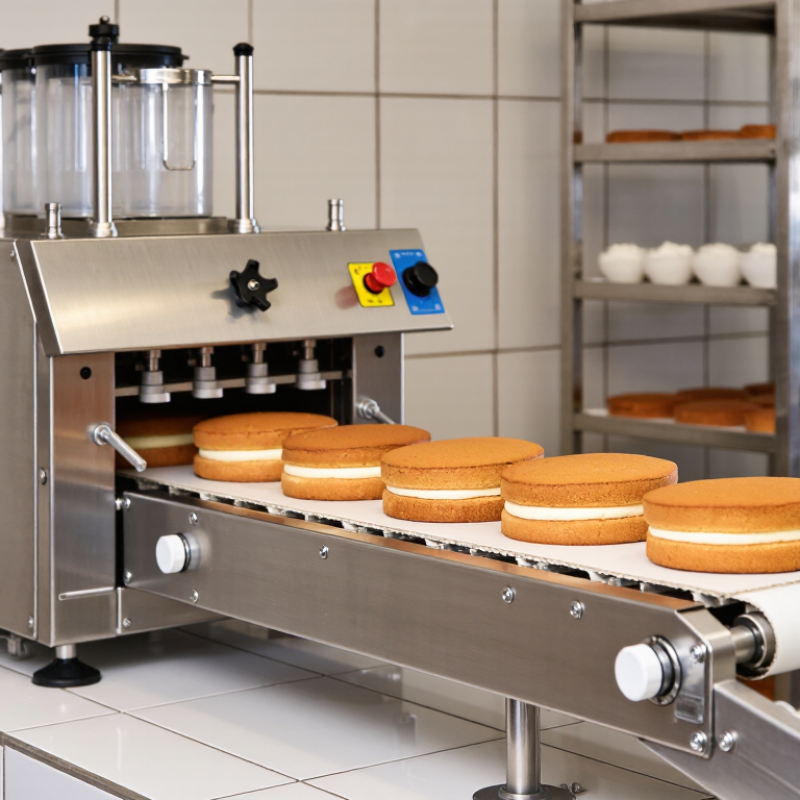
Before comparing machine speeds, define the cake format. A filled sponge layer, a rolled cake, and a square sandwich cake need different feeding, depositing, and cutting setups. Specify cake dimensions, number of layers, filling type, and whether products arrive as sheets or individual pieces. Small details matter: thick cream may need a wider depositor, while soft sponge can deform under tight guides. Start with the cake.
Next, calculate required good units per hour from actual orders and available production time. For example, 3,200 cakes over an eight-hour shift means 400 saleable units per hour before allowing for cleaning, changeovers, and rejects. Vorne’s OEE Industry Benchmarking guide cites about 60% as typical manufacturing effectiveness and 85% as a world-class benchmark. Use these figures as planning references, not machine guarantees. A rated speed of 700 units per hour may not deliver 700 acceptable cakes consistently. I would request a trial using your recipe and packaging; the result can be less tidy than a brochure suggests.
Tips: Ask suppliers to document sustained output, not a brief peak. Record cake size, filling, operator count, changeover time, and reject rate during the test. Then compare hourly good output with your demand, leaving room for growth without buying capacity you cannot use.

How to Choose the Best Sandwich Cake Machine?
Compare Depositing, Filling, Layering, and Cutting Functions
A sandwich cake machine should match the product, not just the target output. Depositing controls how evenly batter lands in each pan or onto a belt. Check portion accuracy across repeated runs, especially when batter temperature or thickness changes. Small details matter. A narrow nozzle may leave clean edges, but thick batter can slow the flow. Filling systems need similar scrutiny: look for steady cream or jam portions, easy nozzle cleaning, and minimal smearing between layers. Ask whether the machine handles your actual filling, since a smooth cream behaves differently from fruit pieces.
Layering functions affect alignment and cake height. Adjustable guides can help keep each sponge centered, while controlled belt speed reduces shifting. Cutting performance depends on the blade, cake temperature, and product firmness. Test slices on cakes at different temperatures; warm layers may compress, while very cold fillings can resist a clean cut. Not always. During a production trial, record portion weights, layer alignment, cut edges, and product loss. I would not judge a machine from one fast demonstration. A slower test with your ingredients may reveal awkward adjustments or cleanup steps that brochures rarely mention.
Compare the core functions handled by different equipment types. A value of 1 means the function is typically performed or available as part of the equipment; 0 means it is not a primary function. Integrated-line configurations vary.
When comparing sandwich cake machines, inspect the surfaces that touch batter, filling, and wash water. 304 stainless steel typically contains 18–20% chromium, along with nickel and other elements. Chromium helps form a thin protective layer that slows rust and staining. It is useful, not magical. Strong cleaners, salt, and moisture left in seams can still cause problems over time. The steel grade matters, but so does how the machine is designed and maintained.
Ask for material documentation for product-contact parts rather than relying on a shiny finish. A polished panel alone does not confirm its alloy. Check corners, welds, and narrow gaps where cream or crumbs may collect; these areas need to be accessible during cleaning. It is easy to overvalue the grade number on a specification sheet. I would also compare the manufacturer’s cleaning instructions with the ingredients you plan to use. Salted fillings or frequent wet cleaning may call for closer attention to rinsing and drying. Look carefully at the details.
When choosing a sandwich cake machine, check that every food-contact surface is suitable for the ingredients, temperatures, and cleaning methods used in your kitchen. Request material declarations and relevant test documents, then confirm they match the machine’s actual parts. Stainless steel alone does not tell the whole story. Seals, belts, coatings, and dispensing nozzles matter too. Small details matter. Look for smooth joints and accessible areas where cream or crumbs could collect. A certificate folder is useful, but it cannot replace a practical cleaning check.
Apply HACCP’s seven principles to the machine’s role in production: analyze hazards, identify critical control points, set critical limits, monitor them, define corrective actions, verify the plan, and keep records. For example, assess contamination risks during filling and assembly, then decide which controls are essential. Record checks such as cleaning completion, product temperature, or metal-detection results when relevant to your process. Specify what staff should do if a limit is missed, and who verifies the response. Review the plan when recipes, equipment, or workflows change. Paperwork can look complete while a hard-to-reach corner stays dirty, so inspect the machine during real cleaning, not just during a sales demonstration.
| Selection area | What to check | Evidence or practical test | Decision guidance |
|---|---|---|---|
| Food-contact compliance | Identify every surface that may contact cake, filling, frosting, or food-contact packaging, including belts, hoppers, nozzles, scrapers, seals, and lubricants. | Request material specifications and supplier declarations for the intended food type, temperature, and contact duration. Check applicable local requirements, such as relevant EU food-contact rules or applicable U.S. FDA regulations. | Do not rely on a general “food-grade” claim alone. Confirm that each material is suitable for its specific use and destination market. |
| Hygienic design and cleaning | Look for accessible product zones, smooth and durable surfaces, minimal crevices, and parts that can be removed or opened for cleaning and inspection. | Review cleaning instructions and the machine layout. Observe a full cleaning and reassembly cycle; check that no product residue remains in seams, joints, or hollow areas. | Prefer equipment that can be cleaned and inspected consistently using the facility’s validated procedures. |
| Capacity and product handling | Match line speed, portion range, cake dimensions, filling viscosity, and layer count to the actual production plan. | Run representative products at expected operating speeds. Record output, portion variation, downtime, and product damage. | Compare demonstrated performance under your operating conditions, not only the rated maximum speed. |
| HACCP Principle 1: Conduct a hazard analysis | Assess biological, chemical, and physical hazards associated with ingredients, product handling, equipment materials, cleaning, and maintenance. | Document the hazard analysis with the food-safety team and consider the machine’s product-contact points and intended use. | Use the analysis to identify controls; purchasing a machine alone does not establish food safety. |
| HACCP Principle 2: Determine critical control points | Decide whether any process step controlled by or around the machine is a critical control point (CCP). | Apply the facility’s documented CCP decision process to the product and process. Record the reasoning. | Do not automatically treat every machine setting as a CCP; CCPs depend on the specific hazard analysis. |
| HACCP Principle 3: Establish critical limits | For each CCP, define measurable limits that distinguish acceptable from unacceptable control. | Use scientifically supported limits appropriate to the hazard, product, and process, such as a validated time or temperature limit where relevant. | Set limits in the HACCP plan, not from a machine brochure or an unverified default setting. |
| HACCP Principle 4: Establish monitoring procedures | Determine what is monitored, how, how often, and by whom for each CCP. | Check that relevant readings or checks can be recorded reliably, and that instruments are suitable and calibrated where required. | Monitoring should be practical during normal production and should identify loss of control in time to act. |
| HACCP Principle 5: Establish corrective actions | Plan what staff must do when monitoring shows a deviation from a critical limit. | Document how affected product is identified and controlled, how process control is restored, and how the event is recorded. | Confirm that operators can safely stop, isolate, or adjust the process as specified in the plan. |
| HACCP Principle 6: Establish verification procedures | Verify that the HACCP system and its controls are implemented and effective. | Plan appropriate reviews, record checks, calibration, inspection, and validation activities for the process and equipment. | Choose a machine that supports access, inspection, and dependable records where these are needed. |
| HACCP Principle 7: Establish documentation and record-keeping | Maintain records for hazard analysis, CCP monitoring, corrective actions, verification, and relevant equipment maintenance or cleaning. | Check whether operating procedures and records can be integrated into the site’s document-control system. | Keep records clear, current, and appropriate to the food-safety plan and applicable requirements. |
| Allergen changeovers | Assess whether the machine can be cleaned effectively between products containing different allergens. | Review disassembly and cleaning steps, then verify the facility’s allergen-cleaning procedure using an appropriate method. | Consider dedicated parts or production scheduling when the site’s risk assessment indicates they are necessary. |
| Maintenance and serviceability | Check access to wear parts, availability of maintenance instructions, and controls for preventing contamination during repairs. | Review the preventive-maintenance plan and inspect how tools, fasteners, lubricants, and replacement parts are managed. | Include maintenance-related contamination risks in prerequisite programs and the facility’s food-safety system. |
Regulatory obligations vary by country, product, and intended use. Confirm applicable requirements with qualified food-safety and regulatory personnel before purchase and installation.
When comparing sandwich cake machines, measure changeover time with the products you actually sell. Switch from a cream-filled layer to a fruit topping, then record minutes spent adjusting guides, nozzles, and portion settings. A quick demonstration on one recipe can hide slower changeovers on another. Downtime hurts. Ask for repeat trials and include setup labor in the cost calculation.
Cleaning is a production cost, not a footnote. Check whether food-contact parts detach without tools, whether corners trap icing, and how long sanitation takes between shifts. The CDC estimates that 48 million people in the United States get sick from foodborne illnesses each year. That figure is not specific to bakery equipment, but it underscores why cleanable design and documented procedures matter. Small parts matter. Request cleaning instructions and observe a full washdown before purchase.
Compare warranty coverage for motors, controls, and wear parts, then check response times and service availability. The National Restaurant Association’s 2024 State of the Restaurant Industry report identifies food and labor costs as ongoing pressures for operators. Build total cost of ownership around purchase price, installation, training, cleaning supplies, energy, maintenance, and lost output during repairs. A spreadsheet still misses awkward shifts. Test the machine during a realistic production run, and note rejected cakes, operator effort, and any steps that depend on one experienced worker.
Same Day Shipping
ISO Certified Production