Choosing stainless steel forgings for global sourcing requires more than comparing prices and delivery dates. The right decision connects material performance, manufacturing control, documentation, and long-term supplier reliability. A forging may look excellent on a drawing yet fail when exposed to chloride, pressure, repeated loading, or high temperatures.
Details matter. Buyers should define the required grade, forging method, dimensions, tolerances, heat-treatment condition, and surface finish before requesting quotations. Common options, such as 304, 316, 17-4 PH, and duplex stainless steel, offer different balances of corrosion resistance, strength, toughness, and cost. The best grade depends on the service environment, not on popularity alone.
Practical sourcing experience shows that supplier evaluation deserves equal attention. Review furnace control, die maintenance, nondestructive testing, machining capability, and inspection procedures. Ask for heat numbers, material certificates, mechanical test results, and dimensional reports. Traceability should follow each batch from raw material to final shipment. Test everything.
An experienced supplier can explain why a specification may be excessive, incomplete, or unsuitable for production. That conversation often prevents expensive redesigns. However, no checklist is perfect. Even a qualified manufacturer may face variation in lead times, raw material availability, or export documentation. Buyers should confirm these risks in writing and use independent inspection when the application is critical.
This guide explains how to compare stainless steel forgings across suppliers and regions. It focuses on evidence rather than impressive claims. Clear specifications, verified processes, realistic logistics, and responsive communication create a more dependable sourcing decision. The lowest quotation may not be the lowest total cost. Reliability has a price.
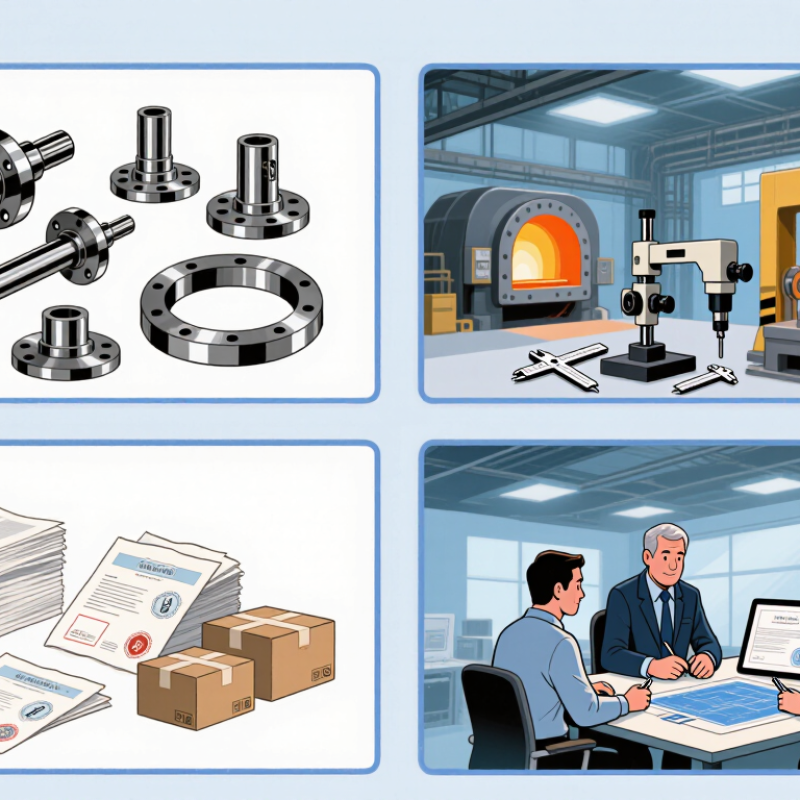
Stainless steel forgings are metal components shaped by compressive force, usually through hammers or presses. The process refines grain flow and can improve strength, fatigue resistance, and dimensional reliability. Common applications include valves, shafts, flanges, and pressure-bearing fittings. However, stainless steel is not automatically corrosion-proof. Grade selection, heat treatment, surface condition, and service temperature all matter.
In global sourcing, forgings connect material engineering with controlled international production. A buyer should define the grade, forging temperature, dimensions, tolerances, heat treatment, and inspection requirements before requesting quotations. Mill certificates, heat numbers, hardness results, and non-destructive testing records support traceability. Clear drawings help, too. Small gaps hurt. “Stainless steel forging” alone is not a complete specification.
From practical sourcing experience, supplier evaluation should include process capability, equipment condition, quality history, and communication speed. Ask how rejected parts are identified and how corrective actions are recorded. Review sample forgings for die marks, folds, machining allowance, and surface cracks. A trial order can expose problems that documents hide. Packaging deserves attention because moisture, impact, and mixed heat numbers may damage control during ocean transport. I have seen technically acceptable parts delayed by unclear inspection timing. That mistake is easy to repeat. A realistic sourcing plan should allow time for design clarification, first-article approval, testing, and possible rework.

Choosing stainless steel forgings for global sourcing starts with the material grade, but grade alone is not enough. Define the service environment first. Chloride exposure may require 316L rather than 304. Higher strength and improved resistance may point toward duplex 2205. Confirm the grade through chemical analysis, not only a supplier’s quotation.
Standards must match the component’s function and destination market. ASTM A182 may apply to pressure-related forged parts, while EN specifications can govern European projects. Request the exact standard revision, heat-treatment condition, and inspection class. A forged ring should arrive with a heat number, material test certificate, and traceability records. Small documentation gaps create large sourcing risks.
Specify mechanical properties in measurable terms. Include minimum yield strength, tensile strength, elongation, hardness, and impact toughness when low temperatures matter. Also state test direction, specimen location, and testing temperature. A 3.1 inspection certificate can support verification, but it does not replace independent inspection for critical parts. I have seen buyers accept “stainless steel” without defining solution annealing. That shortcut caused confusion during final machining. It was avoidable. Dimensional tolerances, surface condition, and corrosion testing may deserve equal attention. Requirements should be written before comparing prices, because cheaper steel often reflects missing controls rather than better efficiency.
How to Choose Stainless Steel Forgings for Global Sourcing?
Choosing stainless steel forgings begins with matching the forging method to the part’s geometry and service demands. Open-die forging suits large, simple components and flexible production volumes. Closed-die forging delivers better repeatability for complex shapes, but tooling costs require careful volume planning. Ring rolling can improve grain flow in circular parts. Ask how the method affects strength, waste, lead time, and machining allowance.
Tolerance claims need practical examination. A drawing may show tight dimensions, yet forged surfaces usually require later machining. Confirm datum references, flatness, concentricity, and allowance before comparing quotations. Request sample inspection reports, not only promised figures. Small errors compound. Trial parts should be measured with calibrated equipment under controlled conditions. A supplier that explains deviations openly is often more reliable than one offering perfect numbers.
Quality control must follow the material from melt to shipment. Require heat-number traceability, chemical analysis, mechanical testing, hardness results, and dimensional records. For critical applications, discuss ultrasonic or other suitable non-destructive testing. Review calibration schedules, operator qualifications, process approvals, and corrective-action records. An independent audit can reveal gaps hidden behind polished documentation. Still, no system is flawless. Sampling may miss isolated defects, and inspection plans sometimes become routine paperwork. Define acceptance criteria clearly, retain objective evidence, and revisit the plan after the first production batch.
Choosing stainless steel forgings for global sourcing requires more than comparing unit prices. Start by screening suppliers against documented production experience, stable quality systems, and responsive communication. Request recent material certificates, heat-treatment records, and inspection reports. ISO 9001 is useful, but it does not prove forging quality alone. Check whether the supplier can provide EN 10204 3.1 certificates, hardness results, dimensional reports, and traceability from billet to shipment.
Production capability should match the part, not merely the catalog. Confirm available forging methods, press capacity, alloy experience, maximum dimensions, and achievable tolerances. Ask how defects are detected. Ultrasonic testing, magnetic particle testing, and visual inspection may all be relevant. Review tooling ownership, die-life assumptions, machining support, and sample approval procedures. A factory visit or independent audit can reveal details that polished documents miss.
Compare total landed cost instead of the quoted piece price. Include tooling, testing, machining, packaging, freight, insurance, duties, and expected scrap. Request a cost breakdown with clear validity dates. The lowest offer may exclude inspection or maintenance charges. That is a common surprise. A spreadsheet can still mislead when delivery delays stop production. Build a small pilot order with defined acceptance criteria, then measure consistency across batches. No comparison is perfect. Allow room to revise the supplier score after real shipments, customer feedback, and corrective-action performance.
| Evaluation Dimension | Profile A Small-Batch Specialist | Profile B Mid-Volume Integrated Supplier | Profile C High-Volume Forging Plant | Buyer Verification Point |
|---|---|---|---|---|
| Typical order quantity | 10–500 pieces per part number | 500–10,000 pieces per part number | 10,000+ pieces per part number | Confirm minimum order quantity, annual volume commitment, and tooling ownership. |
| Common stainless grades | 304/304L, 316/316L, 410, 17-4 PH | 304/304L, 316/316L, 321, 347, 410, 17-4 PH | 304/304L, 316/316L, 410, 420, 17-4 PH; additional grades subject to melt schedule | Match the grade to the applicable ASTM, EN, or customer material specification. |
| Typical forging method | Open-die or small impression-die forging | Closed-die forging with CNC machining and heat treatment | Automated or high-throughput closed-die forging | Review parting-line design, grain-flow requirements, flash control, and die life. |
| Approximate forged weight range | 0.1–25 kg per piece | 0.2–80 kg per piece | 0.1–50 kg per piece, depending on press capacity and geometry | Request equipment tonnage, maximum envelope, and confirmed part-specific capacity. |
| Heat-treatment capability | Solution annealing and basic aging; external processing may be used | In-house solution annealing, quenching, stress relief, and precipitation hardening | Controlled continuous or batch furnaces with production traceability | Verify furnace calibration, process records, hardness results, and applicable heat-treatment standard. |
| Machining and finishing | Basic turning, drilling, deburring, and pickling | CNC turning, milling, grinding, passivation, and electropolishing through an integrated or approved process | Dedicated CNC lines, automated deburring, passivation, and surface inspection | Confirm dimensional capability, surface roughness limits, passivation method, and inspection frequency. |
| Quality certifications | ISO 9001 is commonly available; certification status must be checked | ISO 9001; ISO 14001 may be available; sector approvals depend on the supplier | ISO 9001 is common; ISO 14001, ISO 45001, IATF 16949, or PED-related controls may be available | Validate certificates through the issuing body, scope, site address, and expiry date. |
| Material documentation | Mill test certificate and dimensional report upon request | EN 10204 3.1 certificate, heat-number traceability, hardness, and chemical analysis | Full batch traceability, process records, inspection plans, and statistical quality data | Specify EN 10204 3.1 or 3.2, positive material identification, and document retention period. |
| Inspection equipment | Calipers, micrometers, hardness tester, and basic visual inspection | CMM, spectrometer, hardness tester, and ultrasonic or magnetic-particle testing through qualified personnel | CMM, spectrometer, calibrated gauges, UT, MPI, liquid penetrant testing, and process SPC | Define inspection method, sampling level, acceptance criteria, and calibration requirements. |
| Indicative piece-price position | Highest unit cost; lower tooling burden for prototypes and low volumes | Balanced unit cost and tooling amortization for repeat orders | Lowest unit cost at stable high volume; higher initial tooling and qualification cost | Compare total landed cost, not only the quoted piece price. |
| Typical tooling approach | Soft or modular tooling; suitable for development work | Dedicated steel dies with documented maintenance and repair control | Dedicated multi-cavity or automated tooling for repeat production | Clarify tool material, trial quantity, tool ownership, maintenance fees, and replacement terms. |
| Prototype lead time | Approximately 3–6 weeks after drawing approval | Approximately 5–10 weeks, depending on tooling and testing | Approximately 8–14 weeks when production tooling and process validation are required | Obtain a milestone schedule covering drawing review, die trial, first article, and approval. |
| Repeat-order lead time | Approximately 4–8 weeks | Approximately 6–12 weeks | Approximately 8–16 weeks, including production planning and shipping preparation | Confirm raw-material availability, capacity reservation, and holiday or shutdown schedules. |
| Best-fit application | Prototype parts, maintenance components, and low-volume industrial items | Industrial equipment, pumps, valves, food-processing equipment, and repeat OEM orders | Automotive, energy, fluid-control, and other stable high-volume programs | Select capacity based on annual demand, design complexity, qualification risk, and delivery expectations. |
| Global sourcing risk | Greater dependence on subcontracted heat treatment or testing | Moderate risk; verify subcontractor control and business continuity planning | Lower unit-cost risk but potentially higher dependency on a single high-volume source | Assess dual sourcing, export documentation, Incoterms, logistics route, and corrective-action response time. |
Note: Lead times, quantities, weight ranges, and cost positions are indicative sourcing benchmarks. Final values depend on part geometry, grade, standards, tooling, inspection scope, order volume, origin, and shipping terms.
How to Choose Stainless Steel Forgings for Global Sourcing?
Selecting stainless steel forgings requires more than comparing price and tensile strength. Verify the material grade, heat treatment, dimensional reports, and complete traceability. Each forging should connect to a heat number, inspection record, and approved drawing. Ask for independent test results when the application carries high pressure or fatigue risk. Certificates may look complete. They can still hide weak verification.
Logistics and contracts deserve equal attention. Confirm packing methods, corrosion protection, export documents, customs responsibilities, and realistic lead times. Define inspection points before production begins. Your contract should address acceptance criteria, nonconforming parts, delayed shipments, drawing changes, tooling ownership, and replacement costs. Include a clear delivery term and payment schedule. Long-term supply risk also matters. Assess furnace capacity, raw material access, backup production, and disaster recovery. A single approved source may simplify quality control, but it creates vulnerability.
Tips: Request a sample traceability package before placing a large order. Compare promised capacity with recent production evidence. Keep at least one qualified backup source when downtime is expensive. Review supplier performance every quarter, not only after problems occur. Do not rely on certificates alone. That is a common mistake. A cheaper forging can become costly through rework, customs delays, or unstable supply. Your risk plan will probably have gaps, so test it with a realistic shipment failure scenario.
Same Day Shipping
ISO Certified Production