Choosing the right Wireless Energy Meter in 2026 requires more than comparing screen size and advertised accuracy. Homes, offices, workshops, and small factories now produce different energy patterns. A device that works well in a quiet apartment may struggle beside motors, inverters, or long wireless distances. This guide examines the practical details that influence reliable measurement, installation, and long-term value.
Accuracy should match the job. For example, a household user may need clear daily consumption data, while a facility manager may require load profiles and demand alerts. Check the meter’s measurement range, current transformer compatibility, sampling method, and stated accuracy under real operating conditions. Wireless performance matters too. Thick concrete walls, metal cabinets, and crowded networks can weaken signals. Wi-Fi, Bluetooth, Zigbee, and cellular models each involve different setup requirements and operating costs. Security deserves attention. Use strong passwords, supported firmware updates, and a reputable mobile platform.
Small details matter.
A trustworthy selection process also includes certification, data ownership, warranty coverage, and installation safety. Confirm whether the meter is suitable for the local electrical system, and consult a qualified electrician for fixed wiring. Product pages sometimes highlight peak accuracy while overlooking standby power, cloud fees, or difficult calibration. I have found that a cheaper meter can become expensive after repeated replacements and unreliable readings. Still, no device is perfect. Wireless interference, sensor placement, and changing network conditions can distort results. The goal is not to find a flawless product, but to choose a well-supported meter whose limitations are clearly understood.
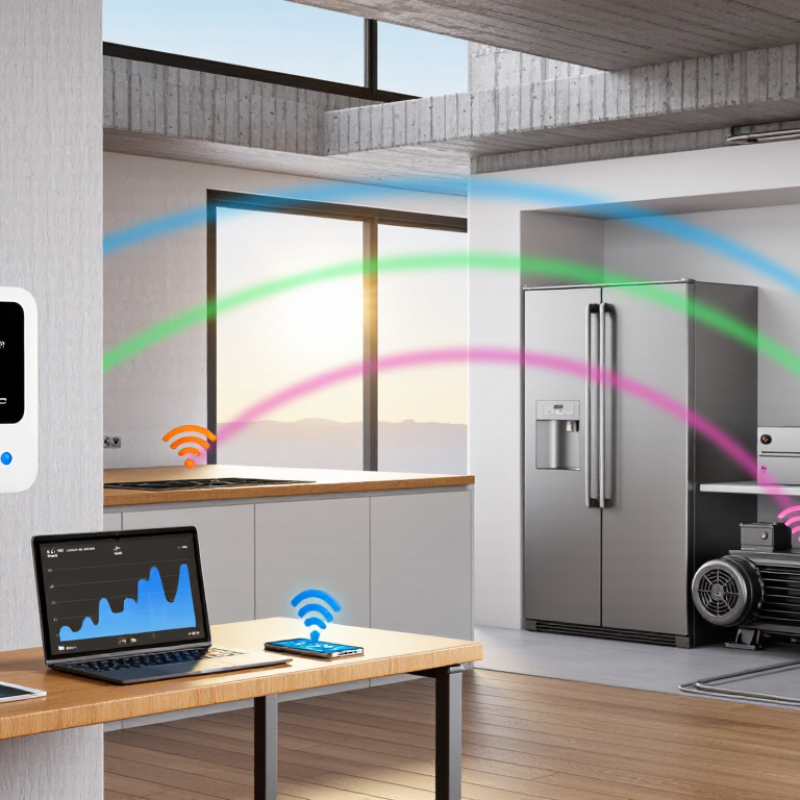
A wireless energy meter measures electricity without sending readings through a wired data connection. It usually monitors voltage and current, then calculates power in watts and consumption in kilowatt-hours. A current transformer clips around a conductor. A voltage sensor provides the reference. A small processor samples both signals and transmits readings through Wi-Fi, cellular, Zigbee, or LoRaWAN.
The data can reach a gateway, building platform, or secure cloud dashboard. Sampling frequency matters. A basic meter may show ten-minute intervals, while an advanced model can reveal short motor starts or standby losses. The IEA’s Electricity 2024 report forecasts global electricity demand will rise by more than 2,500 terawatt-hours between 2024 and 2026. That growth makes timely load visibility more valuable, especially in factories, offices, and solar-equipped homes. Yet wireless does not mean effortless.
When choosing a meter in 2026, check measurement accuracy, isolation design, operating temperature, communication range, and local data storage. Verify whether the device measures single-phase or three-phase systems. Also ask how often readings are transmitted and whether the battery can be replaced safely. The GSMA Mobile Economy 2024 report projects cellular Internet-of-Things connections to approach 5.8 billion by 2030, supporting wider remote monitoring. Still, a crowded radio environment can interrupt updates. I have seen dashboards look precise while missing short outages. Do not trust a smooth graph alone. Compare readings with a certified reference meter before using the data for billing, maintenance, or investment decisions.

When choosing a wireless energy meter in 2026, compare measurement quality before connectivity. The IEA’s Electricity 2024 report expects global electricity demand to grow by 3.4% annually through 2026. Small errors can therefore become expensive across many circuits.
Check the meter’s accuracy class and test conditions. Look for clear data on voltage, current, power factor, active energy, and reactive energy. A useful device should record both consumption and abnormal peaks. Verify its sampling interval, timestamp accuracy, and ability to export raw data. One-minute readings may reveal motor starts that hourly data hides. That detail matters.
Wireless performance needs practical testing. Compare Wi-Fi, cellular, or low-power network coverage inside metal cabinets and basements. Check whether readings remain stored during signal loss. They should. Battery life, operating temperature, and isolation ratings also deserve attention. IEC 62053 accuracy standards offer a useful reference for electricity metering performance. NIST Cybersecurity Framework 2.0 recommends identifying, protecting, detecting, responding, and recovering from cyber risks. Apply those ideas to encryption, user permissions, firmware updates, and audit logs. The meter should support open protocols where possible, such as Modbus or DLMS/COSEM. Compatibility claims can be vague. Test them with your existing gateway before purchase. Industry reports often emphasize interoperability, yet field installations still expose unexpected data gaps. That is an uncomfortable but valuable reality.
Comparison of common wireless energy-meter configurations. Specifications are typical selection ranges and should be verified against the meter’s datasheet, installation method, and applicable local regulations.
| Comparison Dimension | Single-Phase DIN-Rail Meter | Three-Phase Direct-Connection Meter | Three-Phase CT-Connected Meter | Revenue-Grade Cellular Meter |
|---|---|---|---|---|
| Typical application | Apartments, small offices, lighting circuits, and individual loads | Small commercial buildings, workshops, and balanced or unbalanced three-phase loads | Large feeders, industrial panels, solar inverters, and high-current installations | Remote sites, multi-location portfolios, tenant billing, and utility-style monitoring |
| Electrical system | 1-phase, typically 120/230 V AC | 3-phase, typically 230/400 V AC or regional equivalent | 3-phase voltage input with external current transformers | 1-phase or 3-phase, depending on the certified model |
| Current measurement | Direct current path; commonly 5–45 A or 5–100 A | Direct current path; commonly up to 63–100 A per phase | External CTs; common primary ratings range from 100 A to 2,000 A | Direct or CT-connected; rating must match the certified installation configuration |
| Core measurements | Voltage, current, active power, power factor, frequency, and imported energy | Per-phase voltage/current, total active power, reactive power, power factor, and energy | Per-phase values, bidirectional active energy, reactive energy, demand, and power factor | Certified energy registers, time-of-use data, demand, event logs, and tamper records |
| Typical active-energy accuracy | Often Class 1 or equivalent for monitoring applications | Often Class 1; some models provide higher accuracy under specified conditions | Commonly Class 0.5 or Class 1, depending on meter and CT accuracy | May be Class 0.5S, Class 0.2S, or another approved class; certification is essential |
| Wireless communication | Wi-Fi, Bluetooth commissioning, or sub-GHz mesh | Wi-Fi, Ethernet gateway, sub-GHz mesh, or RS-485 gateway | Sub-GHz mesh, Wi-Fi gateway, Ethernet, or private cellular gateway | LTE-M, NB-IoT, 4G, or another regionally supported cellular service |
| Recommended data interval | 1–15 minutes for energy dashboards and load trends | 1–15 minutes for phase comparison and facility monitoring | 1–5 minutes for demand analysis; shorter intervals may increase storage and network needs | 15-minute intervals are common for billing and demand analysis; configurable by service plan |
| Bidirectional energy | Optional; confirm separate import and export registers | Usually available on models designed for distributed generation | Strongly recommended for solar, storage, and microgrid applications | Normally required when energy settlement or export compensation is involved |
| Power-quality features | Basic frequency and power-factor monitoring | Voltage imbalance, phase loss, frequency, and power factor may be included | May include harmonics, voltage sag or swell detection, and phase imbalance | Select only if the certified meter specifies sampling method and power-quality accuracy |
| Demand measurement | Optional rolling demand, commonly based on 5–30-minute intervals | Useful for small commercial peak-demand tracking | Recommended for industrial load management and capacity planning | Should support the interval and calculation method required by the tariff or billing rule |
| Data storage during outages | Often limited local memory; verify records and time-stamp retention | Typically stores recent intervals locally or through a gateway | Prefer non-volatile memory with configurable interval history | Should include non-volatile interval storage and store-and-forward transmission |
| Installation and safety | DIN-rail mounting; qualified electrical installation required | Panel installation with phase identification and correct torque requirements | CT polarity, phase sequence, burden, insulation, and shorting arrangements must be checked | Use an approved wiring diagram, sealed interfaces where required, and a qualified installer |
| Security requirements | Encrypted wireless connection, unique credentials, and secure firmware updates | Device authentication, encrypted transport, and role-based access are recommended | Add certificate-based authentication, network segmentation, and audit logging | Require secure boot or signed firmware where available, encrypted cellular transport, and remote credential management |
| Best choice when | You need affordable circuit-level visibility with simple installation | You need phase-by-phase monitoring for a small or medium facility | The load exceeds direct-meter current limits or requires flexible CT ratios | The meter supports commercial settlement, remote access, and multi-site deployment |
Choosing a wireless energy meter in 2026 means choosing its communication path carefully. Wi-Fi suits homes with stable broadband and nearby routers. It can deliver frequent readings, but it may drain batteries faster. Cellular NB-IoT or LTE-M works better in remote buildings. Low-power wide-area networks can cover long distances with modest energy use. Field testing matters. A concrete wall can weaken signals more than a product sheet suggests.
IoT Analytics estimated 18.8 billion connected IoT devices worldwide by the end of 2024. GSMA Intelligence also forecasts continued multi-billion growth in cellular IoT connections through 2030. These figures support long-term connectivity planning, not automatic approval of every standard. Ask whether the meter supports secure firmware updates, network authentication, and local data storage during outages. Check coverage inside basements and metal cabinets. A cheap connection can become expensive when monthly fees, gateways, or replacements accumulate. Standards evolve. A meter using an older network may become difficult to maintain before its sensor fails. I prefer open protocols and documented APIs, although interoperability is still imperfect. That limitation deserves attention.
Choosing a wireless energy meter in 2026 starts with the installation site, not the app. In field inspections, cramped panels and weak signals cause more failures than advertised accuracy. Measure enclosure space, circuit type, conductor size, and distance to the gateway before ordering. A clamp sensor should close fully around the conductor. It must not press against insulation. Keep the antenna away from metal barriers where possible. Test signal strength at the panel, not beside the router. Small detail, major impact.
Compatibility requires more than matching voltage. Confirm single-phase or three-phase operation, current range, frequency, measurement direction, and local electrical standards. Check whether the meter supports the building’s communication protocol and data interval. Some systems report every few seconds; others upload every fifteen minutes. That difference matters for load control. Ask whether firmware updates work without removing the device. I have seen installations pass commissioning, then lose data after a configuration change. The documentation was technically correct, but not clear enough.
Security deserves a physical inspection. Use unique passwords, encrypted connections, signed firmware, and role-based access. Disable unused ports and change default credentials before connecting the meter. Verify where data is stored, who can export it, and how long logs remain available. A secure device should still provide local readings during an internet outage. Do not accept vague claims. Request update policies, vulnerability reporting procedures, and independent test evidence. I would also record the meter’s serial number and installation date. That habit feels tedious. It can save hours later.
Key installation, compatibility, and security checks to verify before selecting a wireless energy meter.
The checklist groups practical verification points: electrical installation, communications compatibility, data security, measurement quality, and long-term maintenance. A higher value indicates more technical checks that should be confirmed before deployment.
Choosing a wireless energy meter in 2026 requires more than comparing purchase prices. The International Energy Agency’s Energy Efficiency 2023 report states that buildings use about 30% of global final energy. Small measurement errors can therefore distort retrofit decisions and monthly budgets. Request the total cost, including installation, gateways, software fees, battery replacement, and calibration. A cheaper meter may become expensive after three years.
Accuracy should be tested under real conditions. Check the declared accuracy class, operating range, power factor, and response to low loads. IEC 62053 measurement requirements offer a useful technical reference. Place the wireless meter beside a certified reference meter for seven days. Compare readings during standby, peak demand, and nighttime operation. Short tests can mislead.
Long-term value also depends on data access and maintenance. Confirm whether readings remain exportable if the platform changes. Review update policies and basic security controls against the NISTIR 8259A IoT baseline. Wireless reliability matters too; thick concrete walls can create missing data. The Global E-waste Monitor 2024 reported 62 million tonnes of electronic waste in 2022. A replaceable battery and repairable enclosure can reduce premature disposal. No shortlist is perfect. I would document every assumption, especially battery life and communication fees, because optimistic specifications often age badly.
Same Day Shipping
ISO Certified Production