A Quick Connect Coupler may look like a small steel fitting, but its seal, valve, and locking sleeve can affect an entire hydraulic circuit. For buyers comparing China’s leading manufacturers, the useful questions are practical: What pressure and flow does the application require? How well does the coupling resist leakage, contamination, and repeated connection cycles? ISO 7241 and ISO 16028 provide established dimensional and performance references for hydraulic quick-action couplings. They help frame technical comparisons, but a standard alone cannot verify a factory’s production consistency.
Industry market reports on fluid-power equipment point to continuing demand across machinery, construction, and industrial applications. Their broad market figures should not be mistaken for quick-coupler sales data; product categories and research methods differ. Andrew Parr, author of Hydraulics and Pneumatics, offers a relevant engineering reminder: component selection must suit the system’s operating conditions. That principle matters at the test bench, where pressure, seal compatibility, and connection cycles reveal more than a polished product photograph.
This guide to China Top 10 Quick Connect Coupler Manufacturers therefore looks beyond catalog claims. It considers product range, documented testing, material options, quality controls, and support for custom requirements. A low purchase price can be attractive. Yet inconsistent tolerances or unclear test records may cost more later. The comparison is not a substitute for factory audits or application-specific trials; it is a starting point for asking better questions.
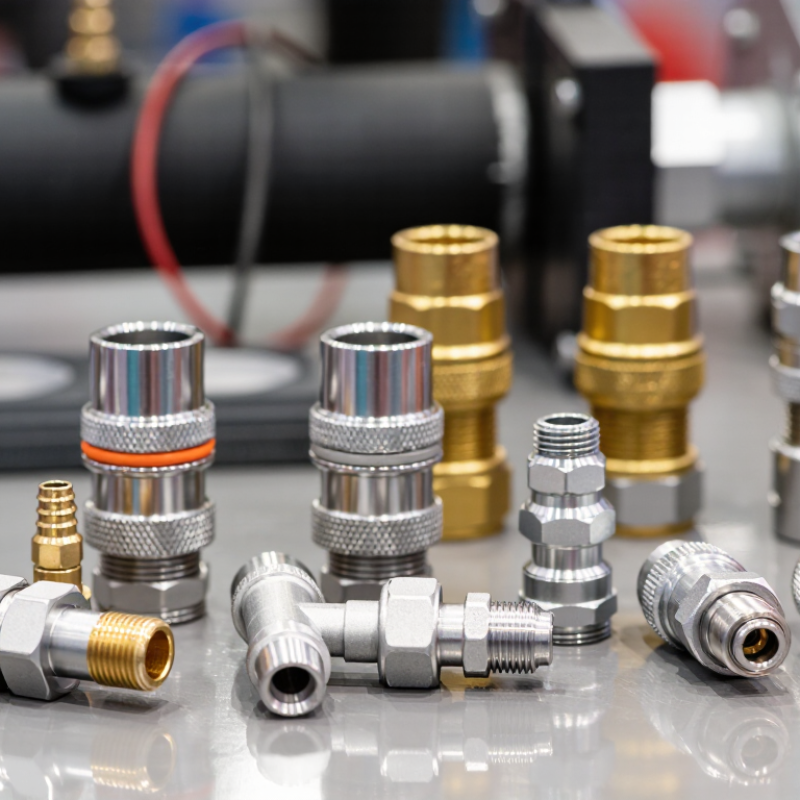
Quick connect couplers join fluid lines without tools. A typical design uses a socket sleeve, a plug, internal valves, and elastomer seals. Push the plug into the socket, and the locking balls engage its groove. The valves open to allow flow. Pull back the sleeve, and the coupling separates; the valves close to limit fluid loss. Simple in motion.
On a hydraulic test bench, a mechanic may hear a click and still need to check the connection. Dirt on the sealing face, a worn seal, or trapped pressure can prevent full engagement. ISO 7241 specifies interchange requirements for certain hydraulic coupler series, but compatibility still depends on the series and operating conditions. Never assume two parts fit safely just because they look alike.
For pneumatic systems, a small leak can waste energy over time. The U.S. Department of Energy’s Improving Compressed Air System Performance: A Sourcebook for Industry reports that leaks in poorly maintained systems may waste 20–30% of compressor output. That figure applies to the whole system, not couplers alone. Still, coupler seals deserve inspection. A faint hiss is easy to ignore, and that is precisely where maintenance habits can fall short.

Quick connect couplers are grouped by connection method and the media they carry. Push-to-connect models allow fast, tool-free changes on pneumatic lines. Threaded and bayonet types suit applications needing a more secure mechanical connection. Hydraulic flat-face couplers help limit fluid spillage during disconnection, while standard poppet designs are common on mobile equipment. Small detail, big consequence: trapped pressure can make even a correctly matched pair difficult to connect.
Applications shape the choice. Pneumatic couplers appear on factory air tools, where repeated hose changes make one-handed operation useful. Hydraulic versions serve excavators, agricultural machinery, and maintenance circuits; a dusty field connection needs effective sealing and easy cleaning. Cooling systems and industrial fluid lines may use couplers selected for flow rate, temperature, and material compatibility. MarketsandMarkets’ Quick Disconnects Market report projected growth from about US$2.3 billion in 2023 to US$3.0 billion by 2028, reflecting demand across industrial and transport uses. Market growth does not guarantee a suitable fit, though. Check pressure ratings, seal materials, flow restrictions, and whether the halves can be connected under residual pressure. In practice, teams sometimes overlook that last point.
Evaluating quick connect coupler manufacturers in China starts with the conditions the coupler must handle. Share the working pressure, fluid type, temperature range, connection size, and expected connection cycles. A supplier should explain how its design fits those requirements, rather than relying on a general catalog description. Ask for material specifications and dimensional drawings, then check that the proposed seals and metals suit your application. Small details matter.
Request sample units and relevant inspection records before making a large order. Check for leakage at the stated working pressure, smooth locking and release, and consistent dimensions across several samples. Ask how production batches are traced and what checks are performed during machining and assembly. A factory visit or independent inspection can help confirm that documented processes match actual production. A polished catalog is not proof. I would still leave room for doubt: sample results cannot guarantee every later batch will be identical. Clear acceptance criteria and written test methods make that uncertainty easier to manage.
Compare manufacturers on technical response, lead time, packaging, and how they handle a reported defect. Specific answers are more useful than broad promises. Keep notes on revisions and agreed tolerances. No checklist catches everything.
Profiles of 10 Leading Chinese Quick Connect Coupler Manufacturers
These ten profiles are best read as capability snapshots, not a verified market ranking. The selection spans makers focused on high-pressure hydraulic couplers, stainless-steel corrosion resistance, pneumatic lines, flat-face designs, agricultural machinery, construction equipment, mining, mold-temperature control, instrumentation, and custom production. China’s manufacturing base is substantial: World Bank data put its share of global manufacturing value added at about 31% in 2022. That scale supports varied supply options, but it does not guarantee consistent sealing or interchangeability. One limitation here: without factory audits and product testing, capability claims remain a starting point for buyer checks.
Tips: Match the coupler to pressure, fluid, temperature, and connection standard. Check leakage and cycle-test records. Fit matters. A quick visual match can miss differences in valve geometry or tolerances. Grand View Research’s hydraulic hose market report identifies construction, agriculture, and mining as important demand sectors—useful context when comparing couplers built for rugged duty with lighter pneumatic models. Ask suppliers for material certificates, pressure ratings, and test conditions; compare like with like. A polished catalogue is not test evidence.
The chart converts commonly referenced nominal coupling sizes from inches to millimeters using the exact factor 1 inch = 25.4 mm. These are mathematical conversions, not flow or pressure ratings; available sizes and actual dimensions depend on the coupling series and applicable standard.
When comparing quick connect coupler manufacturers, check evidence behind their quality claims. ISO’s 2023 Survey of Management System Standard Certifications recorded 1,265,216 ISO 9001 certificates across 189 countries. This shows how widely quality systems are used, but a certificate alone does not prove a coupler will resist leakage or repeated connection cycles. Check that the certificate covers the actual production site, not merely a head office. Ask for material traceability, pressure and impulse-test results, and inspection records for the model you plan to buy.
Look closely at test conditions. A useful report identifies the fluid, pressure, temperature, cycle count, and acceptance limits. Compare those details with your equipment’s working conditions, and confirm compliance with applicable hydraulic-system standards, such as ISO 4413. Small details matter: seal material, dust-cap fit, and connection force can affect field performance. A polished brochure is not test evidence.
Service deserves the same scrutiny. Ask how quickly technical staff respond, whether replacement seals are stocked, and how warranty claims are documented. Request a sample before approving a large order; connect it repeatedly, then inspect for seepage and wear. That takes time. It can still prevent a costly mismatch. I would not rank manufacturers by certificates alone; test reports and real support often reveal more.
Same Day Shipping
ISO Certified Production