What Is the Best ARC Coating Technology in 2026?
ARC Coating Technology can look like a thin, almost invisible layer on glass. Its impact is measurable: less reflected light, improved transmission, and potentially better system performance. But there is no single “best” coating for every lens, display, or solar module. Substrate, wavelength range, humidity, abrasion, and production cost all matter.
The scale of the solar market makes this choice increasingly important. The IEA Photovoltaic Power Systems Programme’s Snapshot of Global PV Markets 2024 reports that roughly 447 GW of photovoltaic capacity was installed worldwide in 2023. That figure does not measure coating performance. It does show why small optical gains, manufacturing consistency, and long-term durability deserve serious evaluation. In the field, dust, cleaning cycles, and weather can challenge a coating that performs well in a laboratory.
This guide compares multilayer vacuum-deposited films, sol-gel coatings, and other established approaches. It considers optical performance alongside adhesion, environmental resistance, process repeatability, and total cost. Testing matters. A high-transmission result alone may hide weak abrasion resistance or uneven coverage across a large panel. We also examine newer processes without treating “new” as proof of “better.” Some trade-offs remain difficult, and published results may not transfer directly between applications. The most suitable technology for 2026 is the one that meets its specification reliably under real operating conditions.
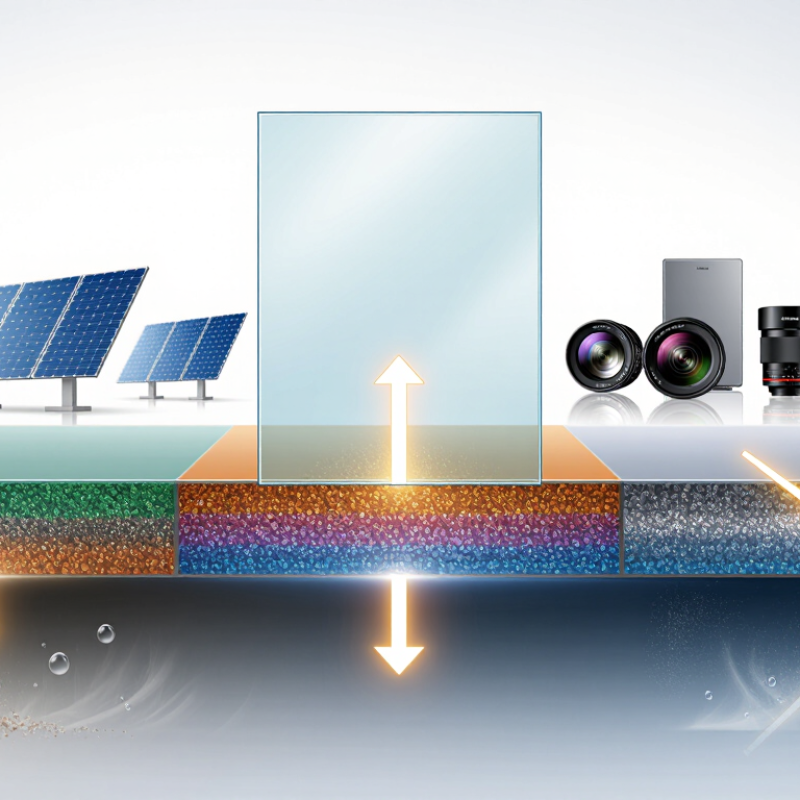
What ARC Coatings Are and How They Reduce Reflection
What Is the Best ARC Coating Technology in 2026?
An anti-reflective coating, or ARC, is a thin optical layer applied to glass or another transparent surface. Bare glass reflects a portion of incoming light at its surface. The coating helps reduce that reflection by controlling how light waves interact. In a simple single-layer design, reflections from the coating’s boundaries can partly cancel each other. This effect works best across a chosen range of wavelengths and viewing angles.
That matters. Multilayer coatings can manage a broader range of wavelengths, while single-layer coatings may suit simpler needs. The right choice depends on the substrate, operating conditions, durability requirements, and the light source. A coating that performs well under indoor lighting may behave differently in sunlight or at an oblique angle. ARC technology is useful, but it is not magic; I would want measured performance data for the actual application before judging a design.
Tips: Check reflectance across the wavelengths you use, not just one advertised value. Ask how the coating handles cleaning, humidity, and repeated contact. Look for test conditions that match your use case. It is easy to focus on lower reflection and overlook color shifts or wear.
What Is the Best ARC Coating Technology in 2026?
Modeled front-surface reflectance across visible wavelengths
This idealized, normal-incidence model compares uncoated glass (refractive index 1.50) with the same glass coated in a single quarter-wave magnesium fluoride (MgF₂) layer (index 1.38), optimized for 550 nm. The coating reduces modeled reflectance near its design wavelength; real-world performance depends on the substrate, coating design, wavelength, and angle of incidence.
How ARC Coating Technologies Differ in Design and Application
What Is the Best ARC Coating Technology in 2026?
How ARC Coating Technologies Differ in Design and Application
Anti-reflective coatings work by reducing reflected light, but their designs solve different problems. A single-layer coating uses a thin film, often tuned to one wavelength. It is simple and economical, yet performance can fall when light arrives at a steep angle. Multilayer stacks cover broader wavelength ranges, making them useful for camera optics and displays. Graded-index and nanostructured surfaces can reduce reflection across wider bands, but require careful control of surface durability and manufacturing.
Application changes the choice. Eyewear needs low glare, clear color, and resistance to scratches. Solar glass prioritizes light transmission and outdoor durability; optical sensors may need precise performance across selected wavelengths. IEA PVPS reported global cumulative solar capacity of about 1.6 terawatts by the end of 2023, showing the scale of one demanding application. Angles matter. So does cleaning.
Grand View Research estimated the anti-reflective coatings market at USD 5.12 billion in 2023, with an 8.4% compound annual growth rate forecast for 2024–2030. Market estimates vary by scope, so they are context, not a technology verdict. In practice, coating selection should test the actual substrate, wavelength range, incidence angle, and wear conditions. A neat lab result may not survive a dusty outdoor surface. That is easy to overlook.
Key Criteria for Evaluating ARC Coatings in 2026
In 2026, the best anti-reflective coating depends on the optical system, not a headline reflectance figure. Start with the operating wavelength and angle of incidence. A coating that performs well in visible light may be less effective near infrared wavelengths. Check reflectance and transmission across the full working range, including off-axis viewing. Small differences matter. They can affect contrast in a camera, display, or sensor.
Durability deserves equal attention. Ask for abrasion, humidity, temperature-cycle, and adhesion test results, and note the conditions used. A strong initial measurement means little if cleaning leaves visible haze or repeated thermal changes cause peeling. Test coated samples on the actual substrate when possible; glass type and surface preparation can change performance. Compare measurements taken with the same method. Otherwise, the numbers may mislead.
Manufacturing consistency is another practical criterion. Review sample-to-sample variation, inspection records, and whether the coating can be produced reliably at the required size. Consider cleaning requirements and expected service life, too. There is a trade-off: adding layers may improve performance in one band while increasing sensitivity to process variation. No single metric captures the whole picture. Evaluation is never perfectly tidy, and a lab result may not predict every field condition. Look for clear test data, stated limitations, and results tied to your use case.
Comparing Leading ARC Technologies Across Common Uses
What Is the Best ARC Coating Technology in 2026?
Comparing Leading ARC Technologies Across Common Uses
Anti-reflective (ARC) coatings reduce surface glare, but the best design depends on the light, material, and environment. A simple single-layer coating can work well on basic lenses, especially when reflections need reducing within a narrow color range. It is often economical, but performance can fall off at other viewing angles or wavelengths. Small trade-offs matter.
Multilayer dielectric coatings use carefully chosen thin films to control reflections across a broader range. They suit camera lenses, optical sensors, and prescription eyewear where clarity and color consistency matter. On glasses, a good coating can make bright shop lights less distracting. On a camera, it can help preserve contrast in backlit scenes. Yet extra layers add manufacturing complexity, and poor surface care can still leave visible scratches.
For solar panels and outdoor displays, broadband coatings can improve light transmission across more of the visible spectrum. Sol-gel coatings offer another route, forming porous layers that reduce reflection; durability and moisture exposure need close attention. There is no universal winner. I would compare measured reflectance, angle performance, abrasion resistance, and cleaning requirements for the actual use. A lab result alone may not predict everyday performance. Some uncertainty remains when real surfaces, dust, and changing light enter the picture.
How to Select an ARC Coating for Specific Performance Needs
The best anti-reflective coating in 2026 depends on the job, not a single headline specification. Start with the operating wavelength: a camera lens used in visible light has different needs from a sensor working near infrared. Check the full spectrum, not just the lowest reflectance figure. That number may describe one wavelength and one angle only.
For broadband performance, multilayer dielectric coatings can reduce reflections across a wider range, but layer design affects cost, durability, and performance at steep viewing angles. A narrowband system may suit a laser assembly better. Ask for measured reflectance at the wavelengths and angles your equipment will actually encounter. A coating that looks excellent on a data sheet can disappoint in a real optical path. Small details matter.
Also consider the substrate, cleaning routine, humidity, and abrasion risk. A delicate laboratory optic may prioritize maximum transmission, while a handheld inspection window needs a tougher surface. Request test conditions and, where possible, compare coated samples under the same lighting and measurement setup. I would not choose from reflectance alone; that is an easy shortcut, and sometimes the wrong one. Even a carefully selected coating can behave differently after installation, so allow time for fit and environmental testing.